Properties of Mesoscopic and Nanoscale Electron Devices
Kinetics of ferromagnetic metal nanoparticles (model)
Devices for Quantum Information Processing
Spin dynamics in double quantum
dots (poster)
Noise of Electric
Current in Mesoscopic SystemsInfluence of inelastic
scattering on shot noise
Current noise due to external time-dependent perturbations
Non-Linear phenomena
in disordered two-dimensional electron systemsCurrent noise due to external time-dependent perturbations
Microwave-induced
magneto-oscillations in 2DEG
Zero-resistance state of irradiated 2DEG
Non-linear current-voltage characteristic of 2DEG
Signatures of the
Kondo effect in electron transportZero-resistance state of irradiated 2DEG
Non-linear current-voltage characteristic of 2DEG
Transport properties of metal
wires with magnetic impurities
Interaction effects between quantum dots in the Kondo regime
SuperconductivityInteraction effects between quantum dots in the Kondo regime
Proximity effect in disordered
and ballistic mesoscopic systems
Charge and Heat transport through superconductors close to the phase transition
Non-equilibrium and Inelastic processes in superconductors
Classical-to-Quantum
CrossoverCharge and Heat transport through superconductors close to the phase transition
Non-equilibrium and Inelastic processes in superconductors
I specialize in theoretical condensed matter physics. I have been developing novel theoretical techniques to describe front-line experiments in quantum electronics and related fields. My primary interest is understanding the kinetics of out-of-equilibrium quantum systems. In such systems, the electron behavior is determined not only by the low-energy electron quantum states, but also by various relaxation mechanisms, which usually originate from the many-particle interaction of electrons with each other or with phonons. Kinetic theory on which I focus analyzes the current experiments and paves the way for further development of quantum electronics. Examples of quantum electron systems are semiconducting quantum dots, ultra-small metal grains and wires, and two-dimensional electron heterostructures.
Kinetics of quantum systems is a fast growing field, which is important for understanding and characterization of electron properties of new materials and for development of nanoscale electronics. The latter promises such fundamental breakthroughs as a realization of solid state devices for quantum information technologies.
 In
collaboration with other researchers, I have succeeded in
presenting an analytical description of several puzzling
phenomena discovered experimentally. Particularly, together with
I. Aleiner and V. Ambegaokar, I have described the transport
through a constrained metallic region, known as a quantum dot,
subject to time-dependent perturbations. By working beyond
the adiabatic approximation, we demonstrated that at high
frequencies the generated direct current can be attributed to a
new shape of the electron distribution function in the dot. My
further work on the analysis of such system led to
characterization of other measurable parameters of the system and
a quantitative comparison of the theory with experiments done at
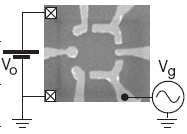
Harvard University (Picture on the left: microphoto of the device
used in Harvard experiments).
In
collaboration with other researchers, I have succeeded in
presenting an analytical description of several puzzling
phenomena discovered experimentally. Particularly, together with
I. Aleiner and V. Ambegaokar, I have described the transport
through a constrained metallic region, known as a quantum dot,
subject to time-dependent perturbations. By working beyond
the adiabatic approximation, we demonstrated that at high
frequencies the generated direct current can be attributed to a
new shape of the electron distribution function in the dot. My
further work on the analysis of such system led to
characterization of other measurable parameters of the system and
a quantitative comparison of the theory with experiments done at
Harvard University (Picture on the left: microphoto of the device
used in Harvard experiments). I. Aleiner and I have also constructed a kinetic theory of two-dimensional electron systems (2DES) placed in a magnetic field in the presence of high-frequency electric fields. Later, together with I. Dmitriev, A. Mirlin and D. Polykov, we applied this theory to the description of the experiments on 2DES subject to high-frequency radiation. We demonstrated that the large amplitude of magneto-oscillations in the experimentally relevant regime is arising from a specific non-monotonic form of the distribution function of electrons in 2DES due to the high-frequency fields. I plan to consider an arbitrary shape of the impurity scattering potential and to investigate the non-linear current in response to a constant electric field investigated experimentally very recently. Another important direction of my research would be to re-apply this theory to an atomic sheet of carbon, a new type of 2DES called graphene.
In the above cases, the external field was considered classically. To describe the interaction effects with quantized electromagnetic fields, such as fields containing small number of
 photons in its modes or fields describing electron-electron
interactions, one has to modify the developed techniques. Such
modification was carried out in my recent paper with A. D. Stone,
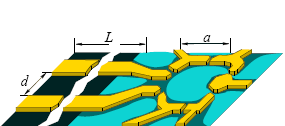
where we calculated electric current through a quantum dot coupled
to quantized electromagnetic field (A schematic picture of the
device is shown on the right). In the near future, I plan to
further develop the theory of electron transport through quantum
systems and consider how different types of interaction influence
transport characteristics of these systems. In addition to the
Coulomb interaction, I will analyze the interaction between
electrons in the Cooper channel that leads to the appearance of
superconductivity. Of particular importance is to calculate the
charge and heat conductances and current noise of small
superconducting devices close to the superconducting phase
transition because these devices are currently the subject a broad
experimental investigation. Such devices are important for
practical realizations of ultra-sensitive detectors of various
spectra of electromagnetic radiation. They also address such
fundamental questions as the thermodynamic and quantum phase
transitions in metal-superconductor systems.
photons in its modes or fields describing electron-electron
interactions, one has to modify the developed techniques. Such
modification was carried out in my recent paper with A. D. Stone,
where we calculated electric current through a quantum dot coupled
to quantized electromagnetic field (A schematic picture of the
device is shown on the right). In the near future, I plan to
further develop the theory of electron transport through quantum
systems and consider how different types of interaction influence
transport characteristics of these systems. In addition to the
Coulomb interaction, I will analyze the interaction between
electrons in the Cooper channel that leads to the appearance of
superconductivity. Of particular importance is to calculate the
charge and heat conductances and current noise of small
superconducting devices close to the superconducting phase
transition because these devices are currently the subject a broad
experimental investigation. Such devices are important for
practical realizations of ultra-sensitive detectors of various
spectra of electromagnetic radiation. They also address such
fundamental questions as the thermodynamic and quantum phase
transitions in metal-superconductor systems.